




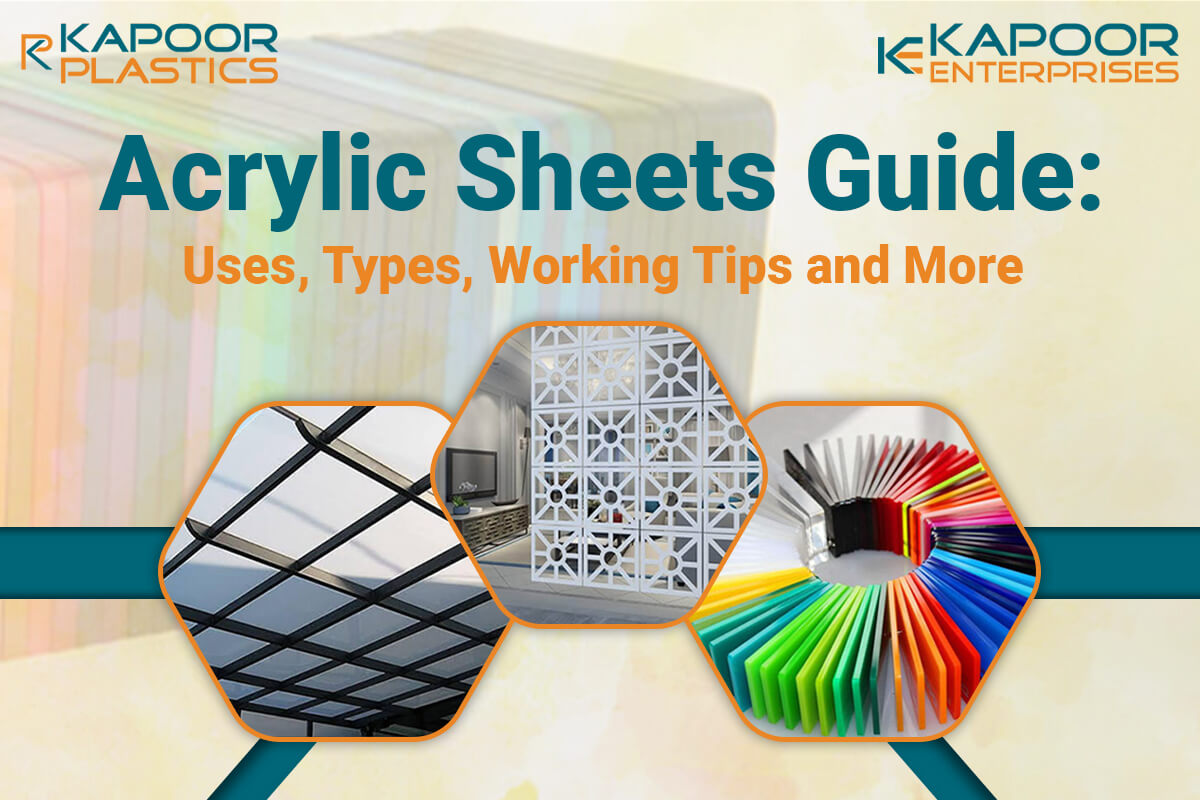

Acrylic sheets have revolutionized the way we approach design, construction, and creative projects. Whether you've walked past a crystal-clear retail display, admired a sleek modern skylight, or noticed a protective barrier at your local store, chances are you've encountered this versatile material in action.
What Are Acrylic Sheets?
Acrylic sheets are clear, rigid plastic panels made from PMMA (polymethyl methacrylate). They offer glass-like transparency with higher impact resistance and lower weight, which makes them a practical choice for architecture, interiors, signage, protective barriers, displays and many other applications.
In the market, acrylic is often referred to by
brand names such as Plexiglass, Perspex or Lucite. PLEXIGLAS® is one of the
original and best-known acrylic brands, recognised for its consistent clarity,
UV stability and long service life. Kapoor Plastics supplies PLEXIGLAS® acrylic sheets so that customers get branded,
performance-tested material rather than unverified generic plastic.
Because acrylic is easy to cut, drill, bend and thermoform, it fits into both simple projects and advanced fabrication work. Whether you need a clear partition, a backlit sign, a skylight, an aquarium panel or a furniture component, the right acrylic sheet can combine appearance, safety and durability in a single material.
This guide explains the key advantages and disadvantages of acrylic sheets, the different types available, common uses, basic cutting and handling tips, and what to consider when selecting material for your project.
Advantages of Acrylic Sheets
Acrylic sheets are used so widely because they solve several practical problems that come up with glass and other plastics. Below are the key advantages that matter to architects, fabricators, designers and end users.
Excellent optical clarity
Quality acrylic, such as plexiglass solid sheets, offers very high light transmission with a clear, neutral appearance. This makes it suitable for:
- Display cases and retail fixtures
- Signage and light boxes
- Windows, skylights and partitions
You get a bright, clean look without the green tint that can appear in thicker glass.
Higher impact resistance than glass
Acrylic has much better impact resistance than standard glass of the same thickness. It is less likely to shatter into sharp pieces, which improves safety in locations where people move close to the glazing, such as:
- Shops and showrooms
- Schools and offices
- Public counters and reception areas
For most everyday applications, acrylic provides a good balance of strength and appearance.
Lower weight and easier handling
Acrylic sheets are roughly half the weight of glass. This lower weight:
- Reduces load on structures and hardware
- Makes transport and installation easier
- Allows larger panels to be used without excessive support
Installers and fabricators can handle sheets more safely and efficiently, especially on site.
Weather and UV resistance
Acrylic sheets are designed to resist outdoor weathering. It maintains clarity and surface quality for many years when used correctly. This is a major advantage over basic plastics that may turn yellow or become brittle under sunlight.
Typical outdoor uses include:
- Canopies and skylights
- Greenhouse glazing
- Facades, sign faces and cladding panels
Good UV stability reduces the need for early replacement and keeps projects looking presentable for longer.
Easy fabrication and customization
Acrylic sheets can be processed using standard tools and equipment. Common operations include:
- Cutting and trimming
- Drilling and routing
- Bending and thermoforming
- Polishing and edge finishing
- Bonding and assembly
This makes it easier to produce custom shapes, branded elements, complex displays and fitments without specialist glass processing.
Safety and user comfort
Because acrylic is more impact resistant and does not shatter like float glass, it reduces the risk of injury in case of breakage. Edges can also be finished to a smooth, clean profile, which is especially important for:
- Partitions near working staff
- Retail counters and cash desks
- Public information displays
In many environments, this added safety is a key decision factor.
Good balance of performance and cost
Acrylic sheets sit between standard glass and high-end materials like polycarbonate in terms of price and performance. For many projects, they offer:
- Better optical quality and outdoor stability than many low-cost plastics
- Lower weight and easier processing than glass
- Adequate strength for most general-purpose uses
This combination allows designers and buyers to achieve a professional result without moving to far more expensive systems.
Types of Acrylic Sheets Available
Not all acrylic sheets are the same. The way they are manufactured, their transparency level and their surface finish all influence performance, appearance and cost.
Types by manufacturing process
a) Cast acrylic (GS): Cast acrylic is produced by pouring liquid PMMA between glass plates and curing it. Key points:
- Very good optical clarity
- Good surface hardness
- Better resistance to many chemicals
- Slightly higher thickness tolerance
- Well suited for machining, polishing and premium displays
It is often preferred for high quality signage, furniture elements, displays and applications where finish is important.
b) Extruded acrylic (XT): Extruded acrylic is manufactured by pushing molten PMMA through a die. Key points:
- Very consistent thickness across the sheet
- Good for vacuum forming and simple fabrication
- Often more economical than cast acrylic
- Suitable for general glazing, partitions and basic displays
For many standard projects, extruded acrylic offers the right balance of quality and price.
For a closer look at available cast and extruded grades see the PLEXIGLAS® GS and XT grades overview.
Types by colour and finish
Acrylic sheets are available in a wide range of visual options, for example:
- Hi-gloss: For façades, furniture elements and decorative panels, high-gloss surfaces are common. An example is hi-gloss acrylic sheet for deep colour and reflective finishes.
- Satin / frosted: Where a soft, diffused look is needed, satin surface acrylic sheets for privacy and design lighting are frequently used.
- Textured: Patterned or structured finishes are available as textured acrylic sheets for decorative and anti-glare applications.
- Mirror: When a lighter, safer alternative to glass mirror is required, acrylic mirror sheets are often selected for interiors, displays and point-of-sale units.
- Optical grade: For instrumentation, displays and precision components, optical grade acrylic sheets are used where tight tolerances and defined optical behaviour are required.
Formats beyond flat sheets
Acrylic is not limited to flat sheet format.
- Rods and tubes: For structural elements, displays, handrails, light guides and technical components, acrylic rods and tubes provide cylindrical and hollow profiles in various diameters.
- Films: Where very thin, flexible material is required for overlays, printing substrates or protection, acrylic films are used instead of solid sheet.
These variations allow designers and engineers to treat acrylic as a family of materials rather than a single, one-size option.
Types by functional properties
Depending on the application, special grades may be used, such as:
- Heat management: In projects that need to reduce solar gain or heat build up, specialised heat-reflecting acrylic grades for roofing and glazing can be considered.
- LED and light diffusion: For uniform LED backlighting and illuminated signs, acrylic grades developed for LED and light guiding applications help avoid hotspots.
- Impact and resistance: Where higher impact resistance or demanding handling conditions are expected, impact-resistant acrylic sheet grades are often specified.
- Greenhouse: For greenhouse glazing and daylight systems, acrylic grades optimised for solar applications can combine light transmission with outdoor durability.
- Durability: Some formulations focus on long service life and robustness in demanding environments, for example acrylic sheet ranges designed for heavy duty and infrastructure use.
- Noise control and barrier systems: Transparent noise barriers and similar structures may use dedicated products like acrylic sheets designed as soundstop elements, often combined with application-specific design data.
When you specify material for a project, it is important to match the sheet type to the application. Kapoor Plastics can help you select the appropriate PLEXIGLAS® grade based on optical needs, mechanical loads, exposure conditions and fabrication requirements.
Technical Properties and Specifications
Understanding the basic technical properties of acrylic sheets helps you select the right material for each project. The figures below are indicative and can vary slightly by grade, thickness and manufacturer, but they provide a useful reference when comparing acrylic with glass or other plastics.
Material composition
- Polymer type: PMMA (Polymethyl methacrylate)
- Form: Rigid, thermoplastic sheet
Acrylic is a thermoplastic, which means it softens when heated and can be shaped by thermoforming. After cooling, it retains the new shape.
Density and weight
- Typical density: About 1.18–1.20 g/cm³
- Approximate weight: Roughly 50 percent lighter than glass of the same thickness
The lower density is one of the main reasons acrylic is chosen for large panels, overhead glazing and structures where weight matters.
Thickness range
Common thicknesses supplied in sheet form include:
- Thin sheets: 1 mm, 1.5 mm, 2 mm
- Medium range: 3 mm, 4 mm, 5 mm, 6 mm
- Higher thickness: 8 mm, 10 mm, 12 mm and above
Specialty grades and blocks can be produced in much higher thicknesses where required. Kapoor Plastics can advise on suitable thickness based on panel size, load and support conditions.
Optical properties
- Light transmission: Up to about 92–93 percent for clear, colourless sheets
- Appearance: High clarity with good surface gloss
- Colour options: Clear, opal, tinted, coloured and diffusing grades
Acrylic is often selected for applications that need high transparency or controlled diffusion of light, such as displays, light boxes and skylights.
Mechanical properties
Typical mechanical characteristics include:
- Good flexural strength for use in flat panels
- Higher impact resistance than standard float glass
- Stiffness sufficient for many structural and semi-structural uses when correctly supported
While acrylic is tougher than glass, it is not as impact resistant as polycarbonate. For very high impact zones, polycarbonate may still be preferred.
Thermal properties
- Recommended continuous service temperature: Generally up to around 70–80 °C for most grades
- Softening point: Higher than many commodity plastics, but lower than glass
- Thermal expansion: Higher than glass and metal, which must be considered in framing
In outdoor or temperature-variable environments, mounting systems should allow for expansion and contraction of the sheet.
Chemical behaviour
- Resistant to: Many household cleaners, diluted acids and alkalis, oils and greases
- Sensitive to: Strong solvents such as acetone, benzene, certain alcohols and aggressive thinners
Using suitable cleaners and avoiding stress combined with harsh chemicals helps maintain long-term performance.
Cutting, Fabrication and Machining Guide
Acrylic sheets are easy to work with if you use the correct tools and follow a few basic rules. This section gives a practical, high-level guide that fabricators, contractors and even experienced DIY users can follow. For critical or high-value projects, professional fabrication is always recommended.
How to cut acrylic sheets
You can cut acrylic using different tools depending on sheet thickness, accuracy needed and available equipment.
Common tools for cutting:
- Scoring knife (for thin sheets)
- Hand saw or hacksaw with fine teeth
- Circular saw or table saw with a fine tooth blade designed for plastics
- Jigsaw with a fine blade
- CNC router
- Laser cutter (for precision work and polished edges)
Basic steps for straight cuts with a saw:
- Keep the protective film on the sheet during cutting.
- Mark the cut line clearly and apply masking tape along the line to reduce chipping.
- Support the sheet on a flat, stable surface with the cut line fully supported.
- Use a fine tooth blade and moderate feed rate. Do not force the cut.
- Allow the blade to do the work and avoid excessive heat build up.
- After cutting, remove burrs from the edge with a scraper or fine sandpaper.
For thin sheets up to around 3 mm, a scoring knife and snapping method can be used on smaller pieces.
Safety precautions
When cutting or machining acrylic:
- Wear safety glasses and appropriate PPE.
- Secure the sheet so it cannot move unexpectedly.
- Use dust extraction where possible to remove chips.
- Avoid loose clothing near rotating tools.
- Allow hot offcuts or edges to cool before handling.
Correct safety practice protects both the operator and the material.
Tips for clean cuts and avoiding cracks
To achieve smooth, crack free cuts:
- Use sharp blades designed for plastics.
- Keep feed speed steady, not too slow and not too fast.
- Do not remove too much material in a single pass when routing.
- Reduce vibration by supporting the sheet close to the cut line.
- Do not remove the protective film until fabrication is finished.
Cracks and edge damage often come from excessive stress, heat or poor support during cutting.
Drilling and shaping acrylic
Acrylic can be drilled, routed and shaped quite easily with the right technique.
Drilling guidelines:
- Use drill bits suitable for plastics, or modify standard bits by grinding the tip angle.
- Place a scrap piece of acrylic or wood under the sheet to support the exit side.
- Drill at moderate speed with light pressure.
- Allow the drill bit to clear chips regularly.
- Do not overtighten fixings through drilled holes. Allow a small clearance for thermal movement.
Routing and edge finishing:
- Use a router with carbide tipped bits designed for plastics.
- Take several light passes rather than one deep pass.
- After routing, edges can be sanded through progressively finer grits and, if required, polished to a clear finish.
Thermoforming and bending
Acrylic is a thermoplastic, which means it can be reshaped with heat.
Line bending:
- The sheet is heated along a narrow line using a strip heater.
- Once the material softens, it is bent to the required angle using a jig or form.
- The part is held in position until it cools and sets.
Full sheet forming:
- For complex shapes, the entire sheet is heated in a controlled oven to forming temperature.
- The softened sheet is placed over or into a mould.
- After cooling, it retains the new shape.
Care must be taken to heat acrylic evenly, avoid overheating, and follow the recommended temperature range for the grade used. Branded material provides technical data that fabricators can follow for reliable results.
Common Uses of Acrylic Sheets
Because acrylic combines clarity, strength, low weight and easy fabrication, it fits into many different industries. Below are the most common and practical uses:
Architecture and construction
In buildings, acrylic is often chosen when natural light and visual openness are important but weight and impact resistance are a concern with glass. Typical uses include rooflights, canopies, balcony infills and interior partitions in offices and public spaces.
For outdoor elements around houses, terraces and small structures, many projects use acrylic inhome and garden applications, for example side panels, privacy screens or light roofing. Along roads, rail lines or exposed sites, clear screens and barrier walls can be designed with acrylic systems fornoise and wind protection.
Retail, branding and signage
Retail and brand environments rely heavily on clear and coloured acrylic for sign faces, 3D letters, light boxes, display stands and showcases. It presents graphics and products cleanly and can be formed or machined into customised shapes.
For this type of work, many systems are based on material families developed forvisual communication and shopfitting, which cover typical sign, display and POS requirements. Backlit and edge-lit signs often combine clear or opal sheets with dedicated LED and diffusing grades, while high gloss or textured surfaces are used where a particular visual effect is required.
Protective barriers and safety screens
Clear acrylic is frequently used for protective screens and equipment covers where visibility and hygiene are important. Examples include counter screens in retail and offices, desk partitions, machine viewing windows and housings for devices.
In healthcare and laboratory environments, similar materials are used in medical and laboratory equipment, where smooth surfaces, defined optical quality and good cleanability are required. Technical equipment, instrumentation and control panels may also use optical-grade sheets where clear viewing and dimensional accuracy are important.
Interior design and furniture
Inside homes, offices and commercial spaces, acrylic appears in shelves, table tops, cabinet fronts, partitions and decorative wall panels. It allows designers to create light, clean elements that do not visually overload a room and can be combined with wood, metal and lighting.
Many of these applications fall into broader furniture and interior design concepts, where different colours, gloss levels and textures are used to match the overall interior scheme. In residential settings, this often overlaps with smaller home and garden projects such as balcony panels, stair guards or covered outdoor areas.
Industrial, OEM and machinery applications
In industrial and OEM settings, acrylic sheets are used for enclosures, machine guards, indicator covers and housing parts where operators need to see processes or displays while keeping moving parts enclosed. For more demanding conditions, designers may turn to heavy duty or impact modified ranges.
In transport, acrylic has long been used in aviation applications for windows, cabin elements and interior panels that need low weight, clarity and defined performance under load. Similar principles apply in other vehicles that require lightweight, transparent components.
Aquariums and water-related uses
Acrylic is well established in aquariums and water-related structures because it can handle water pressure at lower thickness than glass and offers high transparency. Smaller tanks and displays use standard sheets, while larger aquariums may require thicker, specially designed panels.
Disadvantages of Acrylic Sheets
Acrylic sheets offer many advantages, but they also have limitations that should be understood at the selection and design stage. Knowing these points helps you avoid problems during installation and use.
Prone to surface scratching
Compared to glass, standard acrylic has a softer surface. It can scratch if wiped with rough cloths, handled with dirty gloves or cleaned with abrasive products.
How to manage this:
- Use soft microfiber cloths for cleaning.
- Keep the protective film on as long as possible during fabrication and installation.
- For high-contact areas, consider hard-coated or scratch-resistant grades.
Lower heat resistance than glass
Acrylic cannot tolerate the same high temperatures as glass. At elevated temperatures it can soften or deform, and at very high temperatures it may lose mechanical strength.
Implications:
- Avoid direct contact with high heat sources.
- Do not use near open flames or very hot equipment unless the grade is specified for that use.
- Follow the recommended service temperature for the chosen grade.
Risk of cracking under stress
If holes are drilled too close to the edge, if sharp internal corners are left unrelieved or if fixings are overtightened, acrylic can develop stress cracks over time.
How to reduce this risk:
- Drill with correct clearances for thermal movement.
- Avoid point loads and sharp corners in cut-outs.
- Use appropriate gaskets or bushes around fixings.
- Follow recommended fabrication guidelines.
Sensitivity to certain chemicals
Acrylic has good resistance to many everyday substances, but strong solvents and some cleaning agents can cause crazing, softening or surface damage.
Common mistakes to avoid:
- Using thinners, acetone, benzene or aggressive cleaners on the sheet.
- Cleaning under high stress (for example, immediately after heavy machining without proper stress relief).
Always use acrylic-safe cleaning products and test cleaners on a small, hidden area first.
Thermal expansion and movement
Acrylic expands and contracts more with temperature changes than glass or metal. If panels are fixed too tightly, this movement can cause buckling or cracking.
Design considerations:
- Provide adequate clearances in frames and fixing holes.
- Use suitable glazing gaskets or profiles that allow movement.
- Follow mounting guidelines for outdoor and large panels.
Higher cost than commodity plastics
Compared to very basic plastics, quality acrylic can have a higher initial material cost. However, they generally offer better clarity, UV stability and service life.
Practical point:
- Acrylic is a cost-effective alternative to glass and high-end materials when total performance, appearance and lifetime are considered, but it is not the cheapest plastic by weight.
Maintenance and Cleaning
Regular and correct cleaning keeps acrylic sheets clear and presentable for many years. Using the wrong products or methods can cause scratching, hazing or stress cracks, so a simple, consistent routine is important.
General cleaning guidelines
- Always use a soft, clean microfiber or cotton cloth.
- Rinse off loose dust with clean water before wiping.
- Use mild soap or a neutral detergent diluted in water.
- Wipe gently in straight lines rather than with heavy pressure.
- Dry with a separate soft cloth to avoid streaks.
This basic method is suitable for most day-to-day cleaning of acrylic sheets.
Products to avoid
Do not use the following on acrylic sheets:
- Glass cleaners that contain ammonia or strong alcohol
- Solvents such as acetone, benzene, thinner or turpentine
- Abrasive cream cleansers or scouring powders
- Rough cloths, paper towels with hard fibres or scouring pads
These products can scratch the surface, cause clouding or lead to stress cracking, especially on edges and around holes.
Removing stubborn marks
For fingerprints, light grease or similar contamination:
- Use a slightly stronger solution of mild detergent in warm water.
- Apply gently with a soft cloth and allow a short contact time.
- Rinse thoroughly with clean water.
- Dry with a soft cloth.
If a compatible acrylic cleaner is available from a reputable brand, follow its instructions and always test on a small, inconspicuous area first.
Preventing scratches during use
- Avoid sliding hard objects across the acrylic surface.
- Use protective mats or pads under equipment, display stands or merchandise.
- For worktops or high contact areas, consider using a sacrificial overlay or selecting a scratch-resistant grade where available.
Reducing physical contact and using simple protectors can significantly extend the visual life of the sheet.
Dealing with minor surface damage
Small, shallow scratches can often be reduced or removed through polishing:
- Sand the affected area gently with very fine abrasive papers in stages, keeping the surface clean.
- Finish with a suitable plastic polishing compound and a soft cloth.
This work should be carried out carefully and is usually better handled by experienced fabricators, especially on large or critical panels.
Long term care
- Inspect outdoor panels periodically for dirt build-up and clean as needed.
- Check fixings and support systems to ensure there are no new stress points or sharp contacts.
- Keep a consistent cleaning routine rather than allowing heavy contamination to accumulate.
With correct maintenance, acrylic sheets can retain their clarity and appearance for many years in both indoor and outdoor environments.
Acrylic vs Other Materials
Comparison table: acrylic, glass and polycarbonate
| Property | Acrylic sheet (PMMA) | Glass (float / tempered) | Polycarbonate sheet |
|---|---|---|---|
| Clarity | Very high light transmission, clear and neutral | High clarity, thicker pieces can show greenish edge | Clear, but may show more internal stress in some cases |
| Weight | About 50% lighter than glass at same thickness | Heavy | Slightly lighter than glass, heavier than acrylic |
| Impact resistance | Higher impact resistance than standard glass | Brittle, can shatter into sharp pieces | Very high impact resistance, suitable for safety glazing |
| Surface hardness | Moderate, can scratch if not protected | High, good scratch resistance | Lower than glass and acrylic, scratches more easily unless coated |
| UV and weathering | Good outdoor durability with suitable grades | Good, does not yellow but can be brittle if thin | Needs UV-protected grades for long-term outdoor use |
| Heat resistance | Moderate service temperature (typically up to ~70–80 °C) | High, tolerates very high temperatures | Moderate to high, higher than acrylic for many grades |
| Ease of fabrication | Can be cut, drilled, routed and thermoformed with plastic tools | Requires specialist cutting and processing | Can be cut and machined, forms well with heat |
| Thermal expansion | Higher than glass, needs allowance in frames | Low, dimensionally stable | Higher than glass, allowance also required |
| Scratch resistance | Better than standard polycarbonate, less than glass | Very good | Lower, hard coated grades available at extra cost |
| Relative cost level | Medium | Varies by type and processing | Typically higher than acrylic at same thickness |
| Typical uses | Glazing, partitions, signage, displays, lighting, furniture components | Windows, facades, interior glazing, where hardness and heat resistance matter | Safety glazing, machine guards, impact-prone areas, roofing |
When to choose acrylic over alternatives
Acrylic is the preferred option when you need:
- High clarity for displays, signage, furniture and interior use
- Lightweight panels that are easy to handle and install
- Good outdoor durability with stable appearance over time
- Neat edges and surfaces that present products or spaces professionally
- Cost effective performance without moving to more expensive specialist materials
Glass may still be selected for very high temperature environments or where surface hardness is more important than weight and impact resistance.
Polycarbonate is more appropriate for severe impact conditions, anti-vandal applications or where safety ratings demand very high toughness.
For a more detailed comparison focused specifically on these two materials, you can read our separate article on acrylic vs polycarbonate sheets.
Sustainability and Environmental Considerations
Sustainability is now a regular part of material selection. Acrylic sheets offer several points that support long-term, responsible use when specified and handled correctly.
Recyclability of acrylic
Acrylic (PMMA) is a thermoplastic, which means it can be re-melted and reprocessed under the right conditions. Offcuts and end-of-life sheets can often be:
- Collected and mechanically recycled into regrind for suitable products
- Used in controlled processes that recover monomer for new PMMA
Local recycling options vary, but from a material standpoint acrylic is recyclable, unlike some thermoset products that cannot be reprocessed.
Long service life and durability
A key sustainability benefit of quality acrylic is its long usable life. PLEXIGLAS® grades are designed to resist:
- Yellowing from UV exposure
- Surface degradation in outdoor conditions
- Loss of clarity and optical performance
Long-lasting acrylic reduces the need for frequent replacements, which cuts material use and waste. In some projects, acrylic sheets with recycled PMMA are used to reuse material without changing acrylic performance.
Lightweight structure and resource use
Because acrylic is much lighter than glass at the same thickness, structures can often be designed with:
- Lighter framing and support systems
- Reduced transport weight
- Easier, less equipment-intensive installation
All of these can contribute indirectly to lower energy use in transport and construction compared with equivalent glass solutions.
Maintenance and cleaning impact
Acrylic surfaces can usually be kept in good condition with mild cleaners and simple maintenance routines. This means:
- No need for aggressive chemicals in standard cleaning
- Less frequent refurbishment or replacement if the correct cleaning methods are followed
Consistent, gentle maintenance supports both visual quality and material longevity.
Responsible specification and use
From a sustainability point of view, the most effective approach is to:
- Select the right thickness and grade so the sheet performs without being over-specified
- Plan for responsible handling of offcuts and end-of-life panels, including recycling where practical
For many architectural, retail and industrial applications, a long-lasting acrylic solution can be part of a sensible, resource-aware design strategy, especially when balanced against alternatives that may require more mass, more processing or more frequent replacement.
Buying Guide for Acrylic Sheets
A few clear decisions make choosing acrylic much easier. Use this as a quick checklist before you place an order.
Define the application
Decide where and how the sheet will be used:
- Indoor or outdoor
- Glazing, signage, partition, furniture or cover
- Level of impact, handling and chemical exposure
This will guide the choice of grade, finish and thickness.
Choose a suitable thickness
As a simple rule of thumb:
- 2–3 mm for small covers, frames and light diffusers
- 4–6 mm for most partitions, counter screens and medium signs
- 8 mm and above for larger panels, balcony infills, skylights and aquariums
For large spans or high loads, check thickness with your supplier or fabricator.
Pick type and finish
Select what matches the design and function:
- Clear sheets for glazing and displays
- Opal or translucent sheets for backlit signs and diffusers
- Opaque colours for branding panels and décor
- Textured or frosted surfaces where privacy or glare control is needed
Special grades such as light diffusing, impact modified or scratch resistant can be used where the application demands it.
Check quality and supply
For reliable performance:
- Prefer branded material such as PLEXIGLAS®
- Look for clean surfaces and proper masking
- Use cut to size service where it reduces waste and on-site work
Conclusion: Why Acrylic Is a Practical Choice
Acrylic sheets are a practical option wherever clear, rigid panels are needed and traditional glass presents challenges with weight, impact resistance or processing. They offer high light transmission, lower weight, good impact performance and relatively simple cutting and machining, which is why they are widely used for glazing, partitions, signage, lighting components, furniture elements and industrial covers.
When comparing materials, acrylic typically sits between glass and polycarbonate. It is lighter and more impact resistant than glass, while offering better optical clarity and surface quality than many plastics. Polycarbonate still leads where very high impact resistance is required, but acrylic often provides a better balance of appearance, cost and ease of fabrication for general architectural and commercial applications.
In practice, selecting the right sheet comes down to a few key steps: define the application and environment, choose an appropriate thickness, decide on clear, translucent or opaque appearance, and check that the material’s technical properties suit the expected loads and temperatures. With these points considered, acrylic sheets can deliver consistent, long-term performance across a wide range of projects.
For project-specific questions such as suitable thickness, grade selection or combining acrylic with polycarbonate in the same design, it is typically helpful to discuss the details with your material supplier so that the sheet choice aligns with structural and visual requirements.
FAQs on Acrylic Sheet
An acrylic sheet is a rigid, transparent plastic panel made from PMMA (polymethyl methacrylate). It offers glass-like clarity with lower weight and better impact resistance, which makes it suitable for glazing, partitions, signage, displays, lighting and many types of covers.
Yes, acrylic sheet has significantly higher impact resistance than standard float glass of the same thickness. It is less likely to shatter into sharp pieces, so it is often used where safety, public contact or frequent handling are involved. However, glass still has higher surface hardness and heat resistance.
Acrylic sheets are suitable for outdoor applications when correctly installed. They offer good resistance to UV radiation and weathering, which helps them maintain clarity and surface quality for many years in uses such as canopies, skylights, greenhouses and sign faces.
Low-grade plastics can yellow under UV exposure. Quality acrylic sheets are formulated to resist yellowing, and established brands provide data on long-term outdoor performance. Correct cleaning and avoiding harsh chemicals also help preserve clarity throughout the service life of the panel.
Thickness depends on panel size, support spacing and load. Thin sheets around 2–3 mm are often used for small covers and frames, 4–6 mm for many interior partitions and protective screens, and 8 mm or more for larger panels, glazing and higher load areas. For important projects, it is advisable to confirm thickness with a technical reference or supplier.
Acrylic sheets can be cut with a scoring knife (for thin sheets), a fine tooth hand saw, circular saw, jigsaw, CNC router or laser cutter. The sheet should be supported, the protective film left on, and blades designed for plastics used. Moderate feed rates and correct support help avoid chipping and cracking.
Use a soft microfiber or cotton cloth with mild soap and water. Rinse off loose dust first, then wipe gently and dry with a clean cloth. Avoid abrasive pads, strong solvents, ammonia-based glass cleaners and dry wiping, as these can cause scratching or stress damage.
Yes. Acrylic can be drilled, routed and machined with tools suitable for plastics. Drill bits should be sharp and used at moderate speed with light pressure. Support the sheet from below, allow chips to clear and avoid overtightening fixings. Routing and polishing can produce clear, smooth edges.
Both are clear plastics, but they serve different priorities. Acrylic offers very good clarity, good scratch resistance and stable outdoor appearance. Polycarbonate provides much higher impact strength and is used in more demanding safety applications. For many architectural and display uses, acrylic is sufficient and more economical.
Acrylic (PMMA) is a thermoplastic and can be recycled through appropriate processes. Offcuts and end-of-life sheets can often be reprocessed into new material, depending on local recycling options. Checking available recycling routes during project planning is a good practice when specifying acrylic in volume.